



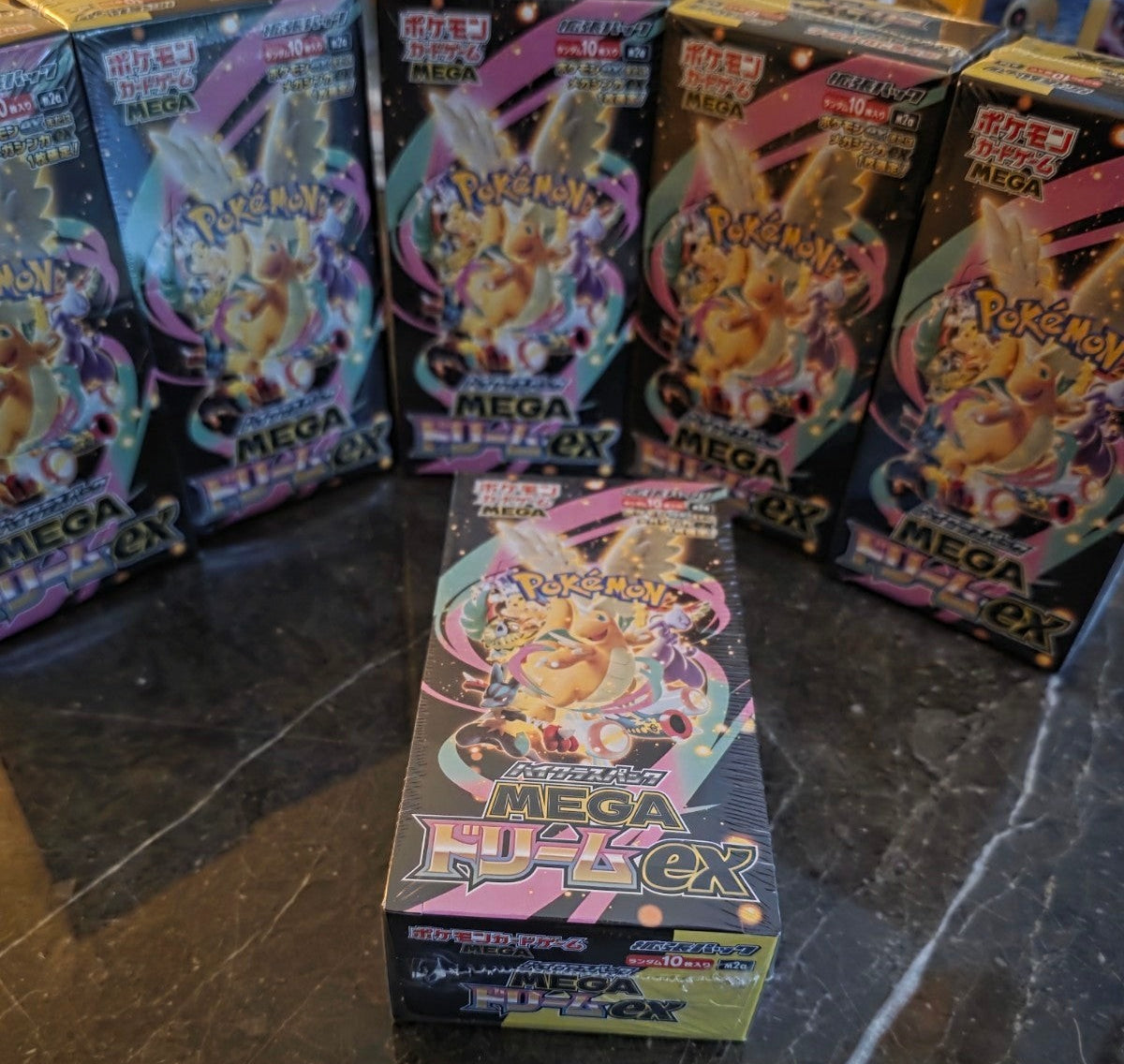
You rarely spot a counterfeit Japanese booster box by its shrink wrap, but you can by the print inside and the crimps of the packs. This week two Inferno X (M2) displays were on our table: one factory original and one that turned out not to be. From the outside both looked fine. Below we show where you do see the difference, with our own photos.
How this ended up on our table
A collector came by with two Inferno X displays. He didn't trust one of them. Together we laid them side by side and looked at everything under a digital microscope. The difference was clear: one display was factory original, the other was not.
We are sharing this because it can happen to anyone who buys Japanese boxes. The shrink wrap looked tight and the barcode matched. That is exactly why it pays to know where else to look.
1. The black on the inner flap
When you open the display, you see a black flap on top with the set logo and a QR code. On the genuine display that black is deep and even, with sharp white letters. On the fake it was a washed-out grey, flat and dull. You can see that difference without a magnifying glass.

2. The crimp of the packs
The crimp is the pressed-shut edge at the top, the bottom and the seam on the back. On a genuine Japanese pack it is pressed tight and flat, with an even orange colour. On the fake the centre seam on the back was not rolled properly: wavy, bumpy and pinkish red instead of orange. Side by side the difference is big.


3. The halftone dots under the microscope
Print is made of tiny dots. Under a cheap digital microscope (around 20 euros) you can see them. The original print had a tight, regular dot pattern with sharp edges. The fake was coarser and more irregular, with ragged letter edges. Compare, for example, the red text ポケモンカードゲーム on the pack. On the fake it is already thicker and blurrier to the naked eye; see the photo of the front above.


4. Colour and print of the box
If you put two displays of the same set side by side, look at the edges and the sides. The colours and the sharpness of the illustration were slightly off on the fake. On its own a small colour difference says little, because genuine print runs differ too. Combined with the points above it is a clear signal.

5. The barcode proves nothing
Both packs had the same JAN barcode, starting with 4521329, the code of The Pokémon Company. Counterfeiters simply copy it. A matching barcode therefore rules nothing out. A barcode that does not match, however, is an immediate reason not to buy.
What this means for the cards
The cards themselves were genuine. That is exactly how this trick works: genuine cards, with the valuable ones taken out, go into counterfeit packs and a counterfeit display, with new shrink wrap around it. Checking the cards for the blue core layer will not help you here. Look at the packaging.
How to protect yourself
- Film your opening without interruption, starting from the closed shrink wrap.
- In doubt? Stop immediately. Don't open another pack or a second box. Keep the wrap, the box, the packs and the cards.
- Compare with a pack you know is genuine, ideally from the same set: crimp, colour, print and weight.
- Buy a complete case if you want certainty. It is sealed by the factory as a whole.
- Buy from a shop that guarantees it. With us, you get your money back if a box turns out not to be factory original. How that works is explained in the Seal Guarantee.
More on checking from the outside: Authenticity and origin, checking a factory-sealed booster box and what no shrink means. In doubt about a box you bought from us? Message us on WhatsApp at +31 6 14 34 87 80.



Share:
Pokémon releases 2027: all new Japanese sets and dates
Aura Seeker (M7): release date, Mega Lucario Z ex and what's in the box